About Knowledge (KaaS)
The Knowledge (KaaS) platform seamlessly ingests both structured and unstructured data from diverse sources, including knowledge bases and documents. By leveraging advanced AI-driven processing, it transforms Intelligent Virtual Assistants (IVAs) and human agents into Subject Matter Experts (SMEs), equipping them with contextually relevant information to address customer inquiries and deliver personalized recommendations. The platform is designed to provide efficient, cost-effective access to enterprise knowledge, empowering agents, analysts, and data scientists to make informed decisions, enhance customer interactions, and optimize operational efficiency.
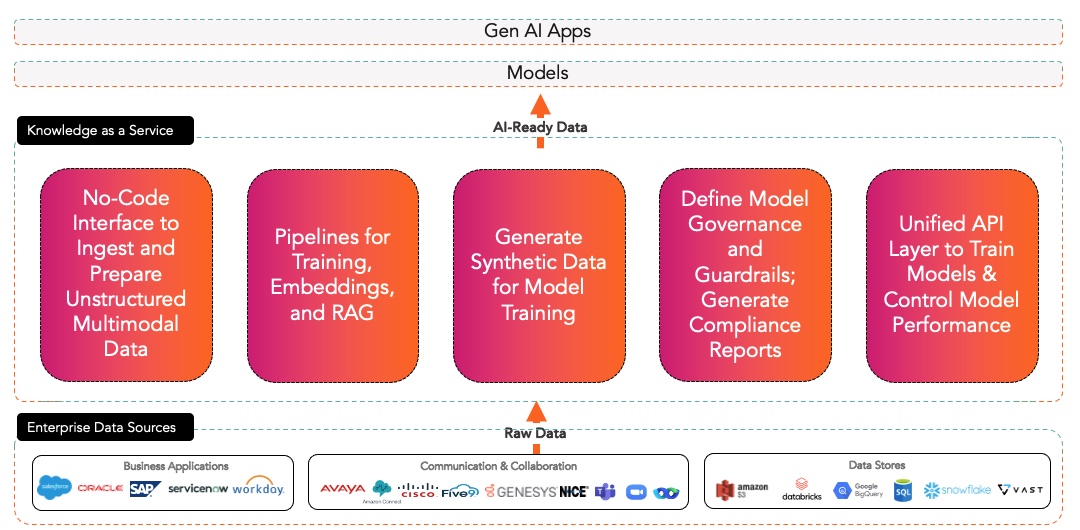
The image below illustrates the structured data hierarchy of the platform, showcasing how data is organized, managed, and utilized to power Gen AI application:
Key Features
Text Data Processing
The platform's core components ensures enterprise-grade safety, security, and governance while processing text data. These components optimize data for use in Gen AI applications through intelligent chunking, categorization, and summarization. Leveraging advanced intent and entity detection, the platform structures and refines information, enabling more accurate, context-aware responses while maintaining compliance and data integrity.
Audio and Video Processing
The platform processes audio and video data to generate high-quality transcripts, making them readily usable for Gen AI applications. These transcripts seamlessly integrate with text data processing capabilities. By transforming multimedia content into structured and actionable knowledge, the platform enhances decision-making and unlocks deeper insights across enterprise data.
Automated RAG Pipeline Orchestration
The platform streamlines the end-to-end RAG process with intelligent automation. From data ingestion and retrieval to model fine-tuning and response generation, the platform optimizes each step, reducing manual effort and ensuring seamless integration with enterprise data sources. This automation accelerates AI deployment, enhances accuracy, and enables businesses to harness the full potential of their proprietary knowledge with minimal operational overhead.
Enterprise-Grade Governance
To ensure robust security and regulatory adherence across all capabilities, the platform provides comprehensive support for Role-Based Access Control (RBAC) along with policy-driven pre- and post-processing mechanisms.
Quality Control and Continuous Improvement
The platform integrates Reinforcement Learning from Human Feedback (RLHF) to enhance the accuracy and relevance of its knowledge generation. This continuous feedback loop refines AI responses, ensuring higher-quality data processing and contextual understanding. By leveraging human-in-the-loop validation, the platform dynamically improves its models over time, driving more precise, reliable, and adaptive AI-driven knowledge solutions.
Data Privacy and Security
The platform is designed to ensure that all data remains within the platform, eliminating reliance on externally hosted Large Language Models (LLMs) or third-party components. This guarantees complete control over sensitive information while maintaining compliance with enterprise security policies. Additionally, all data stored on a physical medium (at rest) is encrypted using industry-standard protocols, ensuring robust protection against unauthorized access and data breaches.
A Large Language Model is a type of AI model trained on vast amounts of text data to understand, generate, and manipulate human language. LLMs use deep learning, particularly transformer architectures, to recognize patterns and relationships in language, enabling tasks such as text generation, translation, summarization, and question answering.
Business Benefits
Enhanced Decision-Making and Productivity |
|
Increased Operational Efficiency |
|
AI Adoption |
|