Architecture Overview
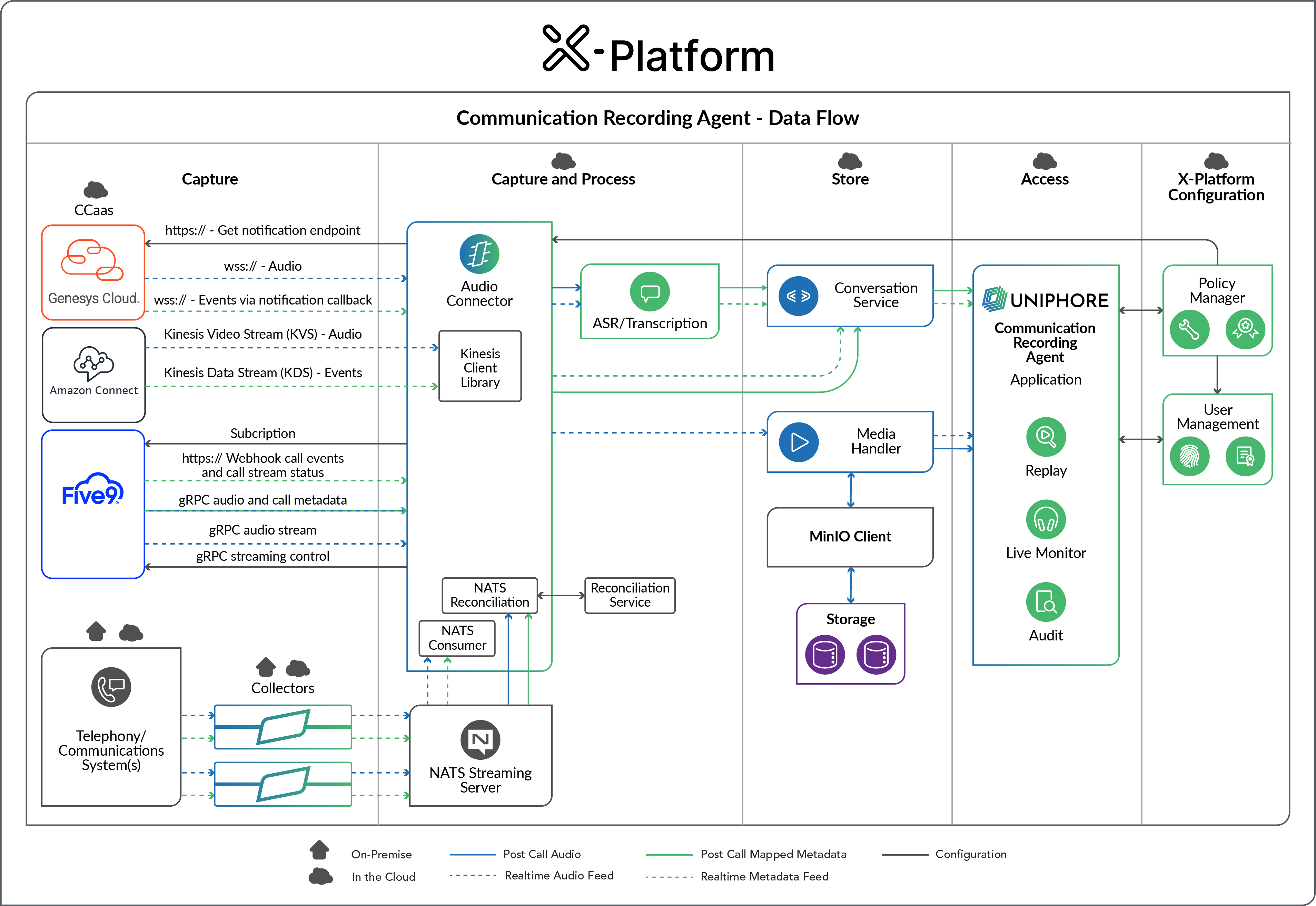
The Communication Recording Agent system is built with various building blocks that work together to capture, process, and provide access to calls. These calls are captured either directly from the telephony/communications system to the audio connector or via Collectors. These calls flow through the Administration Platform components in real-time and are made available in the system.
The building blocks of Communication Recording Agent are summarized below and illustrated in Communication Recording Agent System Architecture Summary. For more details, see Communication Recording Agent System Components.
Collectors: Connects to and captures data from a communications system. Captured media and metadata is packaged into chunks and securely streamed to the Audio Connector via Neural Autonomic Transport System (NATS).
NATS: Streams the data captured by the Collectors to the Audio Connector.
Audio Connector: A central system for captured calls to be directed to, either through the Collectors/NATS or for directly for some cloud integrations. The Audio Connector then passes captured data to the Conversation Service, the ASR, and the Media Handler.
Conversation Service: Manages call metadata. This metadata is used when managing anything to do with calls, user access, retention, storage, export and much more. For example a user can be granted access to calls where specific metadata matches specified values, such as when an agent is in a certain group.
ASR: Automatic Speech Recognition (ASR) transcribes audio (voice-to-text features) for all conversations that come through. Live and post-call services are supported.
Media Handler: Processes audio provided by the Audio Connector. Handles requests between the application and the storage.
S3 Storage: Global Storage facilities for storing call audio, which can be made available using the Media Handler.
Application: Where users and system admins interact with the system. From here, users can search for, replay, annotate, export, delete, and view transcriptions of captured calls, as well as listen to calls live. System administrators can review audit logs, as well as configure elements of the Communication Recording Agent system using Communication Recording Agent policies - determining which calls are retained, when they're removed from the system, if they should be automatically exported, which calls can be accessed by what users, and which calls are transcribed.
Communication Recording Agent System Architecture Summary